When talking hasn’t been enough.
You understand why you feel anxious, overwhelmed, or stuck. You've read the books, listened to the podcasts, talked about it with friends. You have the insight. You just don’t know how to make the shift. Maybe you've even been in therapy before.
And yet your nervous system still reacts like the danger is happening now.
Trauma, chronic stress, burnout, masking, and years of living in survival mode aren't just held in your thoughts—they're often experienced in the body.
Brainspotting helps you gently process experiences that feel "stuck" without requiring you to relive every painful detail.
Healing doesn't always happen by thinking harder. Sometimes your nervous system simply needs the opportunity to finish what it has been trying to process for years.
If you're looking for Brainspotting therapy in Annapolis or virtual therapy anywhere in Maryland, I'd be honored to walk alongside you.
Schedule your consultation today and let's explore whether Brainspotting is the right fit for your healing journey.
FAQs
What is Brainspotting?
Brainspotting is a somatic therapy where we identify a spot (or spots) in a person’s field of vision which connect to a distressing sensation, memory or event. The general idea is that by holding a specific eye position we drop deep into the subcortex of the brain. Accessing the subcortex allows us to make connections and metabolize trauma more gently and rapidly than with talk therapy alone, which is limited to the neocortex, or thinking brain.
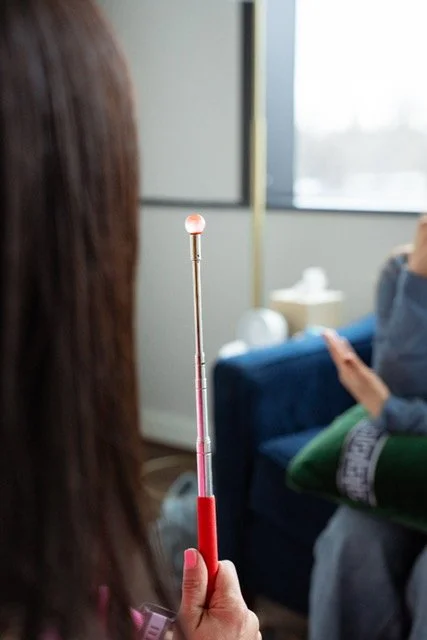
There are many ways to do this in session - to include using a pointer to find the brainspot, using nature, or a gaze spot (the place where your eyes naturally land after gazing around the environment). I then ask where the client notices a sensation in the body. We hold the gaze for as long as is needed for the activation or distress to decrease. Many people find immediate relief and uncover answers from a single Brainspotting session, depending on the issue.
Can Brainspotting be done virtually?
Absolutely! It works just as effectively as it does in person. It is strongly recommended that you do this on a computer or laptop as it gives us more screen in which to find a spot. It is also recommended that you have headphones with you so that you can listen to the accompanying Biolateral music. I find that clients drop deeper into processing while using music.
How long are sessions?
Most sessions are 55 minutes and a typical session will start with a check in where we also identify the issue that you want to brainspot. We will then brainspot for 10-30 minutes depending on what is needed to fully process the issue. Then we will spend about 10-15 minutes debriefing the process and integrating the content of the session.
For some clients that do not want to commit to weekly therapy for various reasons, longer brainspotting sessions are available. These intensives start at 90 minutes and can go up to 3 hours, with breaks, and are usually held over the weekend.
What can Brainspotting help with?
Brainspotting can be used to support clients in almost every capacity. It has been used to help clients recover from trauma, surgery, to decrease physical pain, anxiety, or depression. It can also be used expansively to help clients reach certain goals or get past blocks and build confidence, around public speaking, flying, interviewing, or other performance goals.
What can I expect from a single session?
Brainspotting looks different for every single person, and sometimes, every session is different. Some people have a psychedelic-like experience that is sensory rich where they can feel themselves in nature. Others may feel sensations shift throughout the body and the distress immediately decreases, and capacity for regulation increases. Sometimes the shifts occur incrementally over time, and sometimes there is an immediate shift in behavior. We trust that each brain knows what is needed to heal itself, and the clinician is just here to facilitate the process.